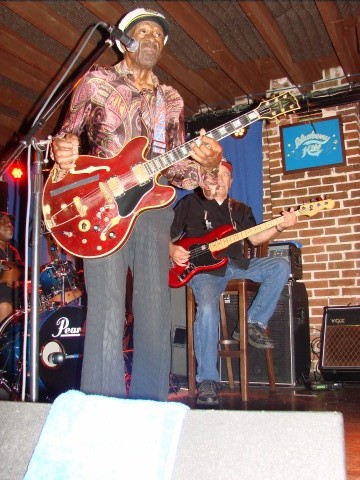
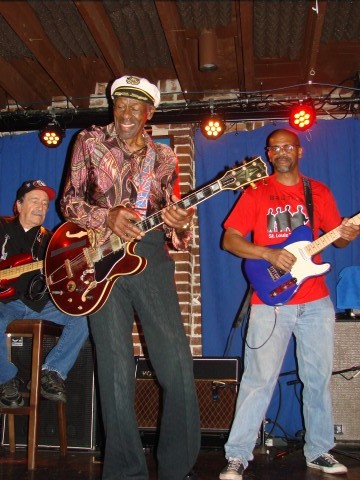
You could almost see it coming. First, two shows in New York City on New Year’s Eve, and then another in Chicago on New Year’s Day. And he didn’t take his band, or even Jimmy Marsala. He travelled alone. Later I’d learn that he had a cold in New York, and saw a report that he’d been pushing a wheelbarrow at Berry Park all day before heading to the first show.
So in Chicago Chuck Berry collapsed on his piano.
The videos were hard to watch. In one he struggled to tune his guitar for a couple of minutes before being escorted off stage. But he kept coming back. He finally apologized to the crowd, told them he’d been checked out by medics, and then did his scoot without a guitar before leaving the stage for good.
Since we are talking about an imaginary friend, I can envision an imaginary and cinematic end. Imagine, perhaps, that he collapses one night many years hence, surrounded by women, surrounded by family, during the frantic final minutes of a particularly good show in St. Louis— one of the big ones at The Pageant with his extended family in attendance. He is taken off stage like Charlie Chaplin at the end of the film Limelight (Chaplin left stuck in a bass drum; Chuck can walk off with help from his son and the band). He has time for comfortable and sweet goodbyes. A long life well lived ends where we saw him live it so vividly—on stage, with family, without an encore.
Right. And we must immediately balance that romantic vision with the image of him arguing with Keith Richards in “Hail! Hail! Rock ‘n’ Roll!”
“I ain’t dying!” he says. And he may be on to something.
It has been interesting watching Chuck Berry grow old. He has done it exceptionally well.
When I first saw him he was young, energetic, strong as a person could be, capable of astounding feats—but at 45, he was already considered one of the “old men” of rock and roll (which, of course, he was.)
When he turned 60 nothing had changed. He no longer had the smooth facial skin of a younger person, but he looked fitter than Keith Richards. Most 30 or 40 year old men would happily take the sculpted upper body he showed off on the cover of his autobiography. I saw live him when he was 62 or 63. He was the same old Chuck Berry. He could still do splits, the duck walk, and the “scoot.”
When I saw him in 2003 it was different. He covered his thinning hair with a cap. It was the first time I saw him act grumpily. He looked older. His face was a bit careworn. He could still play the guitar with panache, but I don’t recall that he did his famous “scoot.”
Then January 2009 at Blueberry Hill. He came out tall, happy, in great voice. (When I saw him in the 1970s his voice was ragged from constant touring. At age 82 he sounded younger, like a 30 year old.) But he looked considerably more frail. He was still tall and lean, but there was a slight hunch to his shoulders. When women jumped on stage his son Charles looked concerned and cautious. Chuck himself ignored the temptations of a 22 year old who was doing her best to interest him. He forgot lyrics now and then. He played interesting rhythm guitar, but he couldn’t pick a lead worth a damn. He seemed to watch his stiff fingers as if in disbelief. He didn’t even try to do the “scoot” that night— but it was a great show, full of energy, humor, and delight.
A year and half later at The Pageant he seemed 20 years younger, grinning slyly, hitting nearly all of the riffs perfectly, singing beautifully. He did the “scoot” several times. It was a beautiful evening.
A few days later he put on another good show, but messed up one song completely because he couldn’t tune his guitar. In fact, he did just the opposite—he twisted and cranked it mercilessly till the notes that exited the pickup bore no relation to what his fingers were doing.
The show had started well— and the crowd never uttered a whisper of complaint. They danced, sang “Go Johnny, Go!" and shouted “Happy Birthday!” and “We love you Chuck!”
He started with “Carol,” “School Day,” and “Sweet Little Sixteen.”
When he asked for requests a guy in full Chicago Cubs regalia yelled “Ding-a-Ling.” He obliged.
But then chaos. After “Ding-a-Ling,” Chuck begins to tune his guitar. I see momentary cringes from both Jimmy Marsala and CBII (whose look seems to say “You’re digging your own grave, pop!”) (Marsala’s expression, though lightning fast, has the character of that oft-repeated movie scene where a person runs towards the camera in slow motion yelling “Nooooooo!”)
But it’s too late. Chuck twists the tuning knobs on his guitar, just a bit. When he looks for approval from his band members and gets a slightly annoyed look instead he stamps his foot and uses a line similar to one heard in Chuck Berry: Hail! Hail! Rock ‘n’ Roll during the famous amplifier scene. “This is how I wish it.” The comment elicits a shrug. I remember Keith Richards in that same film saying “Even when it’s goin’ great he won’ leave it at that (indecipherable drunken slur) the potential to screw it up!” And when I see him tuning his guitar despite all the advice not to, despite the shrugs, (“This is how I wish it!”) I think of the Edgar Alan Poe story “The Imp of the Perverse,” where the hero confesses to a murder he has gotten away with. He describes other sorts of insane actions we take on a daily basis—walking towards a precipice, or procrastinating despite our own best interests. “Examine these and similar actions as we will, we shall find them resulting solely from the spirit of the Perverse. We perpetrate them merely because we feel that we should not.” That’s what I initially think is happening—that my hero likes to tempt fate, push limits, and defy authority, even when it’s against his best interest. It is a standard, worn out interpretation of Chuck Berry.
The first song out is a rocker, and actually, it works. Even though the guitar is partly out of tune, Chuck bends the strings until they sound pretty good. The rhythm carries the song, and disaster is temporarily averted.
But eventually things fall apart, the circle will not hold, and mere anarchy is loosed up the Duck Room— for a few moments, anyway. From off stage we hear Ingrid Berry singing the opening lines of the blues “Rock Me Baby.” There are a few moments of confusion about the key. Then, as the song begins, Chuck attacks the tuning knobs on his guitar a second time— not just tweaking them, cranking them this way and that, like a fishing reel. The result is three minutes of musical chaos, with the band playing one number and Chuck Berry making disjointed but very loud noise in the background.
I’m thinking at the time that it’s passive aggression without passivity. (A passive person might stop playing, but Chuck settles morosely at the back of the stage, leaning his forearm on the bass amp and making loud, incoherent sounds on his guitar, with a look that says—unconvincingly—“this is how we wish it.”)
I follow his fingers as best I can. It looks like he’s playing the proper positions. My guess is that he’s doing a sort of arpeggio that he likes to play during a slow blues while others solo, the one I’d watched him do at The Pageant, admiring the way his long fingers stretched easily across expanses that would make my own tendons shout in agony. He seems to be making the same moves—but the sounds that escape from his giant amplifier are awful—like an animal dying. I’m amazed that Ingrid and the band manage to keep going. She and Charles huddle at one point, eyeing each other with determination.
But all’s well that ends well. When the song finally ends Chuck surrenders his guitar to Jimmy Marsala, apologizes to the crowd (“When it rains it pours,” he says) and accepts a cream colored Stratocaster from his son. There’s a scare when he almost “tunes” that one, but he absorbs a meaningful head tilt from Charles, smiles acceptingly, and launches into another good rocker.
When my sister Rooney heard this story she immediately linked it to hearing loss. She had been reading Oliver Sacks’ book Musicophelia. Sacks describes an elderly composer who loses his sense of pitch because of hearing loss. He thinks his piano is out of tune, especially in the higher registers. In order to continue working the composer has to have his piano deliberately unturned until it sounds right to him.
That might be what Chuck is trying to do. For 60 years he has worked on bandstands in front of loud guitar amps, drum sets, and monitors. He unquestionably suffers from hearing loss. Maybe it has affected his pitch. According to Sacks’ book, the effect can be intermittent, and fades during periods of concentrated musical activity. Maybe Chuck’s properly tuned guitar sometimes sounds wrong to Chuck. Maybe the crazy tuning he sometimes does on stage is simply to make it sound right to himself. But as part of an ensemble he can’t do what the lone composer did. He needs to make it sound right on stage, when the guitar itself might not sound right to him. If Rooney’s theory is right—if he’s suffering from loss of pitch because of hearing loss— it’s a predicament.
He’s getting older, on stage.
For me, and for all of his “rock and roll children,” it’s like watching a parent age, and can be bittersweet. On the one hand, I grant him and admire all that he has earned through his years on earth. He plays and performs with great grace and wisdom. On the other hand, it can sometimes hurt to see him mess up a lick or forget a famous line.
I no longer attend his shows for the music—though when he’s playing with his regular band, or with Daryl Davis, I think the music is authentic and powerful. But I’m prejudiced towards the days when I first saw him perform at South Lake Tahoe and Monterey— convinced that his best musical performances were 40 years ago, when his guitar skills were peaking and his body was still young enough to amaze us with its balletic contortions. In those days he had it all. I don’t expect to see or hear anything like it again.
And although I enjoy them, I don’t go to his concerts to hear the same old songs. The best thing I’ve heard him play in the last three shows was a song called “Love in ¾ Time.” He didn’t even write it, though it fit him to a T. (“I like enchiladas, and old El Dorados that shine!”)
I have no expectation that he’ll ever play the new songs that I’d love to hear, or the lesser known songs that he so rarely plays.
But I go whenever I can because I have to see him. He is important to me. And watching him grow old is important to me. Being with him is important.
I’ve seen various reviews and internet comments encouraging him to “hang it up.” Sometimes it’s just silly—crappy writers taking cheap shots, or unsuccessful club musicians complaining foolishly that Chuck Berry is stealing stage time from the up and comers. But sometimes it hurts. One of the earliest and most cutting (because it was most loving) came from critic and Chuck Berry fan Robert Christigau, who wrote way back in 1973 “Willie Mays was the greatest baseball player who ever lived, but he just can’t cut it anymore. He reminds me more of Chuck Berry every time out.” I know what he meant about Willie Mays. In October 1973 I watched in horror and pain as Mays flopped to his stomach chasing a fly ball in the World Series. Though I respect him, I don’t agree with Christigau, who was panning the pretty danged decent record “Bio.”
But unlike Willie, who had to stop, Chuck keeps going—like Pinetop Perkins, who boogie-woogied until he died at age 97, and like Chuck’s contemporary, B. B. King, who brings a chair to stage now, and often spends as much time telling stories as he does singing or playing guitar.
“We’re in uncharted territory,” Daryl Davis once told me. “We’ve never seen a rock and roller get so old. It’s going to happen to the others. Chuck is showing us how it’s done. He’s still a pioneer.”
When I got to spend a few minutes with him a couple of days before his 84th birthday I was struck most by the human scale of the man—the white hairs, curly now, that bunched out from beneath the back of his cap, the worn fabric of his pants, the thin lines of his face. A few days later I saw him stamp his foot in frustration, and when he cranked his guitar out of tune, I remember thinking that his kids, who obviously love him dearly, are living some difficult moments on stage with their aging father—moments that are usually far more private. (Then again, those same children live moments of great joy with him on stage, too—far more of those than the difficult ones.)
A couple of times I’ve heard of Chuck Berry telling someone “I hope you live 100 years, and that I live forever.”
And of course, in one sense, his eternal life is assured. Bob Dylan called him a survivor and “force of nature.” His music was sent into outer space as “a token of our sounds, our science, our images, our music, our thoughts and our feelings.” Chuck Berry’s legacy will live as long as human culture and technology survive.
But I guess, like the rest of us, he won’t live forever.
Since I began blogging I’ve received e-mails and messages from several fans who worry how they’ll cope when the day comes. (They may be underestimating his endurance, and over optimistic about their own. Who’s to say they’ll outlive him?) One wrote, “Something I think about a lot is: what's going to happen when the day comes when I have to hear that Chuck isn't around anymore? I dread that day. Sounds crazy but the only thing I dread more is the day when my mother leaves me. The world will shrink so much for me when that happens.”
I understand. I used to think about it, too.
I used to wonder what form the news would take, and how big a splash it would make. At first I imagined a small headline. By the late 1970s I knew that it would be a front page story, but I didn’t know how big it would be. With every decade the story has climbed higher and higher towards the masthead and the headline has gotten bigger. We don’t always acknowledge it, but he is a giant of our culture. I think everyone knows by now that he is far more important than the so-called “King,” Elvis. (It is a sore subject for Chuck Berry fans from the 1970s.) He’ll be on the cover of many magazines that he will never see.
His life has already been long and rich. He seems to have lived it full tilt, with little regard for the rules of society, but with a fairly high regard to his fans and his family and to what he perceives as truth. Yes, he can be a grouch, and yes he has been a criminal. He can fuck things up like few can do it. But he has also been an uncompromising and uncompromised person and artist. He has never watered down a thing. He’s been Chuck Berry all the way, and it has served him and his legacy well. He matters to us in a special way.
So when I see him struggling for a moment on stage, I don’t feel more than a minor sting of regret for the loss of his youth and virtuosity. Mostly what I feel is an extreme pride, and awe, that this man I first encountered when I was 14 is still going strong 40 years later at age 84, his guitar still ringing, his name still in lights, his grin as devilish as ever. And though I no longer fear the day that he’s gone, I’m thankful for every moment that he remains, and for every day that he’s been there, for me, for you, for all of us.
(This is part of a book length piece on my imaginary (well, sort of) life with Chuck Berry. You can find the first Chapter over to the right, or CLICK HERE to find the next one!)
41
Wednesday, May 8, 2013
Tuesday, May 7, 2013
Chapter 33 - American History and Practical Math (A Last Encounter)
(This is the next to the last chapter in a book about how Chuck Berry affected my life. Funny how it can happen. This one's all about family, and a final, quick meeting with Mr. Berry, where, for a moment, I affected his life.)
Four score, four years, and exactly two months after Chuck Berry was born, my little Tulane arrived (jumped the counter?) at Swedish Hospital in Seattle. I stood in the hallway during her birth and cried when I heard her strong, raspy voice. (As the song says, down came a tear from her happiness.) My own little girl, Tulane’s mom Jade, had always been interesting and had sometimes been a handful. As a mother and a mom she is hands on and powerful. And now I understand what grandparents say about grandchildren. Leila Tulane looks and feels to me just like Jade and Gemma looked and felt. She is a time machine, delivering me back and carrying me forward. I’ve been one of her babysitters when Jade attends classes and she has become a special friend of mine. She babbles when I babble, barks when I bark, and rubs her lips to go bub-bub-bub-bub-bub just about every time I see her. Her smile restores the soul. She also likes guitars and the piano.
Leila’s mother Jade is teaching herself guitar, taking college classes and intends to transfer to a really good school. She got a modeling contract. She keeps getting 4.0’s. She talks about becoming a lawyer some day. I may try to divert her from that particular destiny, but she has had her own mind since she was born. And now she’s not almost grown, she’s grown. It amazes me.
Gemma remains a poet but seems to have given up piano, at least for now. She currently thinks a stand up acoustic bass would be the thing. (Me too; it’s clever of Gemma to choose a new but expensive instrument that I find irresistible.) Her poetry is remarkable. I’m happiest when I see her take the stage somewhere and read to a huge group. I couldn’t have done that as a kid. (She wouldn’t remember, but she did the same thing when she was in first grade. It was at a coffee shop. I have a picture.) She is beginning her senior year and if we can get the applications in she will soon be off to college. As I type that I begin to feel emotions similar to what I felt in the hospital corridor as Jade gave birth, but the impending tears are happiness mixed with a bit of pain. Chuck Berry called them hurry home drops. I will miss her when she is away. Lord knows what will happen to my Chuck Berry problem without her there to call me out, roll her eyes, and put it in perspective. (“He’s singing about his penis.”) Gemma doesn’t care that much about Chuck Berry, but she tells her elderly teachers about my blog, and follows up to investigate if I tell her about an artist or poet or musician that I think is particularly good. What more can a father want?
Rafferty is my bundle of energy. To my knowledge he has never stopped talking since the day he was born except momentarily when mesmerized by a television commercial. Nor has he stopped thinking. He brings me detailed written plans that far exceed my energy and skill set. (I got the rolling arthritis.) But I do my best. Evidently I am going to build a fort/clubhouse soon.
Rafferty doesn’t like me to talk about the ½ size guitar that Santa brought, which is hard on his fingers, but he can already bang out a decent beat on my old drum set. He likes books and is making me read every word of the Harry Potter books aloud. They are getting hefty and long. I test his attentiveness now and then by substituting his name for Draco Malfoy, or by asking difficult questions about plot turns and minutia. He cannot be fooled.
Rebecca spent the spring and summer training for her first marathon. (I spent the spring training for my third and spent the summer limping.) Every day she carries in huge baskets of zucchini, green beans, tomatoes, peppers, onions, garlic, raspberries, strawberries, lettuce, arugula, potatoes, cucumbers, peas and greens from our tiny garden. She keeps becoming more and more skilled at it. Rebecca saved our lives, and mine in particular. She came into our lives not long after Jade, Gemma and I saw Chuck Berry at the EMP. She accepted challenges few would willingly deal with. The thing people sometimes soothingly and misleadingly call a “blended family” can be a wild mad mouse circus ride with many dramatic ups and downs. We all rode it together. We still hit exciting patches, but more and more we’re in that smooth part at the end, on calm, inviting waters— our reward for hanging in there. On the way Rebecca has accompanied me to see Macy Gray, B. B. King, Billy Preston, Pinetop Perkins and Willie Smith, Sonny Rollins, Dr. John, Hubert Sumlin and Mavis Staples.
And finally, this winter, Chuck Berry.
Rebecca had never seen him—never even watched “the Chuck Berry movie” with me. She put up with him the way she might a far off, cranky but well-loved uncle that I talk too much about. But she got me another ticket to Blueberry Hill, and this time she got one for herself, too. Once again there were two Chuck Berry shows within a matter of days. Rebecca couldn’t attend both, but she let me attend both, and arranged to join me for the second.
The first show was at Blueberry Hill. I met up there with Doug and Blueberry Hill stalwarts Judy and Karen. Judy and Karen have seen more Chuck Berry shows at Blueberry Hill than anyone and have earned permanent seating in the front row. This night, they let us join them there.
Chuck was wild that night, hopping and dancing all over the stage. He almost fell once, so a few seconds later he walked to the very edge of the stage and stood on one foot while dangling the other over the audience. He looked tired and had trouble with the lyrics, but summoned energy from someplace deep within and put on a spotty but wonderful show.
The next day Doug and I made our mad dash to Memphis in my rental car, talking for hours on end, visiting all the studios, eating fried chicken and ribs. We visited Sun Studios, where Howlin’ Wolf recorded “Riding in the Moonlight” and stumbled into a personal tour of Royal Studios from Boo Mitchell, son of the great producer Willie Mitchell. We visited the Lorraine Motel, and peered over the wall outside of Graceland. We talked about work, family and Chuck Berry. (Doug’s wife scolded me good naturedly on speaker phone. “There are only five of you who even care! And two of you are in that car!”) I have a hard time making new friends, but Doug was an old friend right from the start.
We got back to St. Louis in time for me to pick up Rebecca at the airport. The next day we all crossed the Mississippi River to a casino built from an old river boat. Bob Lohr had once again arranged for passes that would get us backstage and allow us to see the sound check. CBII welcomed us, then Jimmy Marsala, Keith Robinson, and Bob Lohr, who was our host that night.
There were three dressing rooms. I was in the hallway outside the one Charles was using when I turned and saw a familiar figure in black in the other room. Doug was near me, and I motioned to him. He looked quickly, then turned back with big eyes. I looked again to see the dressing room door shut slowly and quietly.
When it was time for the sound check we went into the hall where Bob Lohr found us seats in front of the sound board. I didn’t want to lose them, so Rebecca and I stayed put while Doug went backstage again. I had brought a framed copy of the photograph of Chuck Berry as a child. It was my favorite—the one where he is using a telescope. I figured I might not get a chance to give it to him in person, so I handed it to Doug and asked him to give it to Charles. “Ask him to give this to his dad,” I said.
I brought the picture because I knew that at times Chuck Berry will meet fans after a show, and I remembered how, last time, he had told me about the job he’d held as a child. I hoped the picture might inspire another story about his youth.
The show that night was a good one. Bob Lohr says that the casino has good sound. Chuck Berry can hear himself, so his guitar playing is sharp there.
He fiddled with the tuning two or three times but surrendered the guitar to Jimmy Marsala almost immediately each time. Once while the guitar was being tuned he recited a poem—“My Dream”—a piece I knew from my third Chuck Berry album. When he played “Promised Land” he made a remark about “the people were marching” and Birmingham. That thrilled me—an indirect acknowledgment that the song is about more than planes, trains and busses. At the end of the show Rebecca got on stage with several other women and danced with Chuck Berry and his daughter Ingrid. All in all, it was a fine night.
When it was over our passes got us backstage again.
I was a bit disappointed to see the photograph still sitting on a chair in Charles’ dressing room. Then Doug pointed to it and said: “Peter, Charles said you should give that to him yourself.”
“I’ll introduce you,” said Charles.
When Chuck Berry passed through the hallway on his way home Charles stopped him.
“Dad, my friend from Seattle has something for you.”
When I’d met him at The Pageant a year and a half earlier I was struck by the human stature of the man. Chuck Berry had seemed elderly and a bit frail. I remembered the grey hairs that came out from beneath his admiral’s cap.
This time he is tall, regal, in charge and in a bit of a hurry. He is dressed entirely in black in full rock and roll mode with a leather jacket and dark aviator shades. He is now every bit the Father of Rock and Roll
“Seattle friend!” he says, turning to grasp my hand.
I feel like this time I am in control of my emotions. I tell myself that this time I will see and remember everything. He is different, and I am different, too. I will remember this.
I give him the picture of himself, as a child, with his telescope.
He holds it with both hands, slowly lowering his head but raising the picture, focusing through dark glasses on a long lost memory. He shakes his head and utters something like “Oh-wee!”
“Where’d you get this?” he asks me. I tell him that I don’t know—that it’s out there on the internet. My brain is faltering again. I’ve forgotten momentarily that it was sent to me by Peter K. from Sweden.
And then, suddenly, Chuck Berry is on the move.
“I’ve got to show this to Patrick!” he says, or at least I think that’s the name. He looks back at me and points. “And you are going to be there when I do it!”
He walks quickly down the hall to show the picture to several friends near the door. There is a woman who appears to be in charge, and a younger man that I assume is Patrick—another assistant, I’m guessing. The manager of the Casino is also there, beaming. Chuck shows them the photograph but doesn’t let go. The general consensus among Chuck Berry’s friends is that he was probably using the telescope to peer through some girl’s window. Chuck ignores that. I ask if he remembers observing an eclipse of the sun, but he is lost inside the picture and doesn’t respond. When he finally speaks, it is about something more important.
“Look at those shoes!” he says, laughing, pointing to the long, two toned leather “brogans.”
Then Chuck Berry, Rebecca and Charles work together on some American history and practical math. “What’s 1926 plus 11?” he asks Rebecca. They seem like old friends for a moment. 1937 Rebecca and Charles respond simultaneously. I’ve given Chuck a pen and a second copy of the photograph, hoping that he’ll sign it for me. He puts the date “1937” on the top of my copy—close enough to the year 1938, when, Peter K. has determined, an eclipse of the sun could be seen in Chuck’s native St. Louis.
It don’t take but a few minutes but it’s magical. He is visibly moved. A few days later Charles tells me in an e-mail that Chuck Berry took the picture home and showed it to his wife. That makes me happy.
I think of each little touch, from the handshake at Tahoe, to the note and chuckle in Monterey, to the words spoken from stage at the EMP, the stage door encounter at Blueberry Hill where I gave him Rafferty’s picture. The five minutes backstage at The Pageant. Each time I’ve gotten a little closer to something real. Not too close, mind you, but closer.
Before he leaves Chuck Berry raises his aviator shades and looks at me for just an instant.
“He looks like Seattle,” he says, ambiguously, but with finality.
And then he’s gone.
Four score, four years, and exactly two months after Chuck Berry was born, my little Tulane arrived (jumped the counter?) at Swedish Hospital in Seattle. I stood in the hallway during her birth and cried when I heard her strong, raspy voice. (As the song says, down came a tear from her happiness.) My own little girl, Tulane’s mom Jade, had always been interesting and had sometimes been a handful. As a mother and a mom she is hands on and powerful. And now I understand what grandparents say about grandchildren. Leila Tulane looks and feels to me just like Jade and Gemma looked and felt. She is a time machine, delivering me back and carrying me forward. I’ve been one of her babysitters when Jade attends classes and she has become a special friend of mine. She babbles when I babble, barks when I bark, and rubs her lips to go bub-bub-bub-bub-bub just about every time I see her. Her smile restores the soul. She also likes guitars and the piano.
Leila’s mother Jade is teaching herself guitar, taking college classes and intends to transfer to a really good school. She got a modeling contract. She keeps getting 4.0’s. She talks about becoming a lawyer some day. I may try to divert her from that particular destiny, but she has had her own mind since she was born. And now she’s not almost grown, she’s grown. It amazes me.
Gemma remains a poet but seems to have given up piano, at least for now. She currently thinks a stand up acoustic bass would be the thing. (Me too; it’s clever of Gemma to choose a new but expensive instrument that I find irresistible.) Her poetry is remarkable. I’m happiest when I see her take the stage somewhere and read to a huge group. I couldn’t have done that as a kid. (She wouldn’t remember, but she did the same thing when she was in first grade. It was at a coffee shop. I have a picture.) She is beginning her senior year and if we can get the applications in she will soon be off to college. As I type that I begin to feel emotions similar to what I felt in the hospital corridor as Jade gave birth, but the impending tears are happiness mixed with a bit of pain. Chuck Berry called them hurry home drops. I will miss her when she is away. Lord knows what will happen to my Chuck Berry problem without her there to call me out, roll her eyes, and put it in perspective. (“He’s singing about his penis.”) Gemma doesn’t care that much about Chuck Berry, but she tells her elderly teachers about my blog, and follows up to investigate if I tell her about an artist or poet or musician that I think is particularly good. What more can a father want?
Rafferty is my bundle of energy. To my knowledge he has never stopped talking since the day he was born except momentarily when mesmerized by a television commercial. Nor has he stopped thinking. He brings me detailed written plans that far exceed my energy and skill set. (I got the rolling arthritis.) But I do my best. Evidently I am going to build a fort/clubhouse soon.
Rafferty doesn’t like me to talk about the ½ size guitar that Santa brought, which is hard on his fingers, but he can already bang out a decent beat on my old drum set. He likes books and is making me read every word of the Harry Potter books aloud. They are getting hefty and long. I test his attentiveness now and then by substituting his name for Draco Malfoy, or by asking difficult questions about plot turns and minutia. He cannot be fooled.
Rebecca spent the spring and summer training for her first marathon. (I spent the spring training for my third and spent the summer limping.) Every day she carries in huge baskets of zucchini, green beans, tomatoes, peppers, onions, garlic, raspberries, strawberries, lettuce, arugula, potatoes, cucumbers, peas and greens from our tiny garden. She keeps becoming more and more skilled at it. Rebecca saved our lives, and mine in particular. She came into our lives not long after Jade, Gemma and I saw Chuck Berry at the EMP. She accepted challenges few would willingly deal with. The thing people sometimes soothingly and misleadingly call a “blended family” can be a wild mad mouse circus ride with many dramatic ups and downs. We all rode it together. We still hit exciting patches, but more and more we’re in that smooth part at the end, on calm, inviting waters— our reward for hanging in there. On the way Rebecca has accompanied me to see Macy Gray, B. B. King, Billy Preston, Pinetop Perkins and Willie Smith, Sonny Rollins, Dr. John, Hubert Sumlin and Mavis Staples.
And finally, this winter, Chuck Berry.
Rebecca had never seen him—never even watched “the Chuck Berry movie” with me. She put up with him the way she might a far off, cranky but well-loved uncle that I talk too much about. But she got me another ticket to Blueberry Hill, and this time she got one for herself, too. Once again there were two Chuck Berry shows within a matter of days. Rebecca couldn’t attend both, but she let me attend both, and arranged to join me for the second.
The first show was at Blueberry Hill. I met up there with Doug and Blueberry Hill stalwarts Judy and Karen. Judy and Karen have seen more Chuck Berry shows at Blueberry Hill than anyone and have earned permanent seating in the front row. This night, they let us join them there.
Chuck was wild that night, hopping and dancing all over the stage. He almost fell once, so a few seconds later he walked to the very edge of the stage and stood on one foot while dangling the other over the audience. He looked tired and had trouble with the lyrics, but summoned energy from someplace deep within and put on a spotty but wonderful show.
The next day Doug and I made our mad dash to Memphis in my rental car, talking for hours on end, visiting all the studios, eating fried chicken and ribs. We visited Sun Studios, where Howlin’ Wolf recorded “Riding in the Moonlight” and stumbled into a personal tour of Royal Studios from Boo Mitchell, son of the great producer Willie Mitchell. We visited the Lorraine Motel, and peered over the wall outside of Graceland. We talked about work, family and Chuck Berry. (Doug’s wife scolded me good naturedly on speaker phone. “There are only five of you who even care! And two of you are in that car!”) I have a hard time making new friends, but Doug was an old friend right from the start.
There were three dressing rooms. I was in the hallway outside the one Charles was using when I turned and saw a familiar figure in black in the other room. Doug was near me, and I motioned to him. He looked quickly, then turned back with big eyes. I looked again to see the dressing room door shut slowly and quietly.
When it was time for the sound check we went into the hall where Bob Lohr found us seats in front of the sound board. I didn’t want to lose them, so Rebecca and I stayed put while Doug went backstage again. I had brought a framed copy of the photograph of Chuck Berry as a child. It was my favorite—the one where he is using a telescope. I figured I might not get a chance to give it to him in person, so I handed it to Doug and asked him to give it to Charles. “Ask him to give this to his dad,” I said.
I brought the picture because I knew that at times Chuck Berry will meet fans after a show, and I remembered how, last time, he had told me about the job he’d held as a child. I hoped the picture might inspire another story about his youth.
The show that night was a good one. Bob Lohr says that the casino has good sound. Chuck Berry can hear himself, so his guitar playing is sharp there.
He fiddled with the tuning two or three times but surrendered the guitar to Jimmy Marsala almost immediately each time. Once while the guitar was being tuned he recited a poem—“My Dream”—a piece I knew from my third Chuck Berry album. When he played “Promised Land” he made a remark about “the people were marching” and Birmingham. That thrilled me—an indirect acknowledgment that the song is about more than planes, trains and busses. At the end of the show Rebecca got on stage with several other women and danced with Chuck Berry and his daughter Ingrid. All in all, it was a fine night.
When it was over our passes got us backstage again.
I was a bit disappointed to see the photograph still sitting on a chair in Charles’ dressing room. Then Doug pointed to it and said: “Peter, Charles said you should give that to him yourself.”
“I’ll introduce you,” said Charles.
When Chuck Berry passed through the hallway on his way home Charles stopped him.
“Dad, my friend from Seattle has something for you.”
When I’d met him at The Pageant a year and a half earlier I was struck by the human stature of the man. Chuck Berry had seemed elderly and a bit frail. I remembered the grey hairs that came out from beneath his admiral’s cap.
This time he is tall, regal, in charge and in a bit of a hurry. He is dressed entirely in black in full rock and roll mode with a leather jacket and dark aviator shades. He is now every bit the Father of Rock and Roll
“Seattle friend!” he says, turning to grasp my hand.
I feel like this time I am in control of my emotions. I tell myself that this time I will see and remember everything. He is different, and I am different, too. I will remember this.
I give him the picture of himself, as a child, with his telescope.
He holds it with both hands, slowly lowering his head but raising the picture, focusing through dark glasses on a long lost memory. He shakes his head and utters something like “Oh-wee!”
“Where’d you get this?” he asks me. I tell him that I don’t know—that it’s out there on the internet. My brain is faltering again. I’ve forgotten momentarily that it was sent to me by Peter K. from Sweden.
And then, suddenly, Chuck Berry is on the move.
“I’ve got to show this to Patrick!” he says, or at least I think that’s the name. He looks back at me and points. “And you are going to be there when I do it!”
He walks quickly down the hall to show the picture to several friends near the door. There is a woman who appears to be in charge, and a younger man that I assume is Patrick—another assistant, I’m guessing. The manager of the Casino is also there, beaming. Chuck shows them the photograph but doesn’t let go. The general consensus among Chuck Berry’s friends is that he was probably using the telescope to peer through some girl’s window. Chuck ignores that. I ask if he remembers observing an eclipse of the sun, but he is lost inside the picture and doesn’t respond. When he finally speaks, it is about something more important.
“Look at those shoes!” he says, laughing, pointing to the long, two toned leather “brogans.”
Then Chuck Berry, Rebecca and Charles work together on some American history and practical math. “What’s 1926 plus 11?” he asks Rebecca. They seem like old friends for a moment. 1937 Rebecca and Charles respond simultaneously. I’ve given Chuck a pen and a second copy of the photograph, hoping that he’ll sign it for me. He puts the date “1937” on the top of my copy—close enough to the year 1938, when, Peter K. has determined, an eclipse of the sun could be seen in Chuck’s native St. Louis.
It don’t take but a few minutes but it’s magical. He is visibly moved. A few days later Charles tells me in an e-mail that Chuck Berry took the picture home and showed it to his wife. That makes me happy.
I think of each little touch, from the handshake at Tahoe, to the note and chuckle in Monterey, to the words spoken from stage at the EMP, the stage door encounter at Blueberry Hill where I gave him Rafferty’s picture. The five minutes backstage at The Pageant. Each time I’ve gotten a little closer to something real. Not too close, mind you, but closer.
Before he leaves Chuck Berry raises his aviator shades and looks at me for just an instant.
“He looks like Seattle,” he says, ambiguously, but with finality.
And then he’s gone.
(This is part of a book. If you want to start at the beginning, go HERE! If you want to go the final chapter, click HERE.)
40
34 - Postscript
Four months after I asked what she thought of my self-diagnosis the professor of psychology responded.
(Standing in the sun ain’t my shot…)
As I type that line—if you get too close you know I’m gone— I realize that it says everything, about him, sometimes about me. You can’t quite catch him. Or Nadine. Or Maybellene. Get too close and they’re gone.
Certainly he was gone when I drove my old Fiat to Berry Park.
“Is he here?” I asked the lady.
“He’s not,” she answered. “You need to leave.”
I might have had better luck the first time I passed through Wentzville, at age eight.
My brother Paul attended a Catholic seminary in Warrenton, about 40 miles West of St. Louis. It was a cool childhood for him. He escaped our crazy home at age 14 to drive tractors, build a lake and play football. When I first learned about Berry Park, it occurred to me to look for Wentzville on a map. I learned that it was practically next door to Warrenton, and that we had all driven through on our way from Warrenton to Gillespie, Illinois to visit my great Aunt Jennie. (We also passed through St. Louis and East St. Louis that day, making it a sort of trifecta of Chuck Berry history.)
In that summer of 1964 Chuck Berry history was still young, and Berry Park was hopping. Michael Lydon described it as once being “the place for St. Louis blacks” and “almost a country club—wide lawns and cool glades; a swimming pool, barbecue pit, tennis courts and boating ponds for the afternoon, a dance hall for the evening, and a small lodge if couple want to spend the night.” Muddy Waters performed there in the summer of 1964. “Nadine” and “No Particular Place to Go” were both hits when we passed on the interstate. “You Never Can Tell” was about to make its modest climb.
A picture taken at Berry Park that summer tells something of the optimism: a boy and three men in front of a wall with musical instruments. The boy wears a big hat and leans over a snare drum looking supremely cool. He’s probably the age Stevo was. The youngest man has his foot against the wall and holds a saxophone. Another man stands coolly with a red Gibson semi hollow body guitar resting at his feet.
The fourth man—coolest of all—smiles broadly. He wears a white shirt and thin tie. He’s slim and tall and holds a big blond Gibson. He’s happy. This is his place, his family, his time.
Our family trip to Missouri in 1964 was one of the major events of childhood. None of us had been East of Carson City, Nevada. We saw Utah, Colorado, Wyoming, Kansas, Nebraska, Missouri and Illinois. The only family member not in the car the day we drove through Wentzville in 1964 was my father. As usual, he stayed behind.
As I say, I never really knew him. The relationship is for all practical purposes parasocial, as ephemeral as whatever I have with Chuck Berry, but of shorter duration. He died when I was 14, but was dead in some ways long before that. Unlike Stevo, he doesn’t grow older in my imagination. He stays the same. (I don’t. I look more like him every day. Sometimes, passing a mirror at night, he startles me.)
I hope eventually to discard some of the old disappointment and loss.
I remember the image of Chuck Berry and his sister leaning over their father in the film “Hail! Hail! Rock ‘n’ Roll.” The old man grunts with delight as Chuck and his sister tell their stories. The love and admiration are so evident and so unambiguous. Chuck was 60 at the time. His father was quite elderly. If, someday, I can lean over the remaining fragments of my father’s memory and smile as unambiguously as Chuck over his dad, I’ll be happy.
In the meantime, in a quieter, calmer way, I have what I have. He’ll come to me in dreams. He’ll sing out from the car radio. He’ll dance in grainy film. Baby, you can’t catch me!
But I’ve gotten a little closer. Not too close, mind you.
I hope I live 100 years. I want that time with mine.
He, on the other hand, will live forever.
photo credit: Peter K.
(This is the very end of a 35 chapter tale of benign madness-- my lifelong love for a cultural icon. If you want to see how it begins, and read your way back to this spot, click HERE!)
11/19 2:54 55
Hello Peter. You wrote to me some months ago, and although I meant to reply promptly, I got distracted by various deadlines. I recently recalled your email and realized I had never replied at all! Sorry about that.
I think what you described in your email would be referred to in the literature as a “parasocial relationship.” There is a fascinating book on this topic. I have attached a more recent article that might be interesting to you.I was happy to get the email and a proper diagnosis. I struggled through the scholarly article and found that my pathology is comparable to folk who bond with a local weather personality. I can’t deny it. Chuck Berry makes a fine weatherman. Rain comes down, heat goes down. Man they were playing like a hurricane! Imagine him with his map pointing out an area of high pressure. She moves around like a wayward summer breeze, he might say. Or maybe he’ll look at me directly through the screen in that parasocial manner of his, tilt his head forward devilishly (just like in my sketch) and get right to the heart of it: If you get too close you know I’m gone, like a cool breeze.
I think it is so intriguing that people are able to derive comfort, companionship, and enjoyment from this type of imaginary relationship.
(Standing in the sun ain’t my shot…)
As I type that line—if you get too close you know I’m gone— I realize that it says everything, about him, sometimes about me. You can’t quite catch him. Or Nadine. Or Maybellene. Get too close and they’re gone.
Certainly he was gone when I drove my old Fiat to Berry Park.
“Is he here?” I asked the lady.
“He’s not,” she answered. “You need to leave.”
I might have had better luck the first time I passed through Wentzville, at age eight.
My brother Paul attended a Catholic seminary in Warrenton, about 40 miles West of St. Louis. It was a cool childhood for him. He escaped our crazy home at age 14 to drive tractors, build a lake and play football. When I first learned about Berry Park, it occurred to me to look for Wentzville on a map. I learned that it was practically next door to Warrenton, and that we had all driven through on our way from Warrenton to Gillespie, Illinois to visit my great Aunt Jennie. (We also passed through St. Louis and East St. Louis that day, making it a sort of trifecta of Chuck Berry history.)
In that summer of 1964 Chuck Berry history was still young, and Berry Park was hopping. Michael Lydon described it as once being “the place for St. Louis blacks” and “almost a country club—wide lawns and cool glades; a swimming pool, barbecue pit, tennis courts and boating ponds for the afternoon, a dance hall for the evening, and a small lodge if couple want to spend the night.” Muddy Waters performed there in the summer of 1964. “Nadine” and “No Particular Place to Go” were both hits when we passed on the interstate. “You Never Can Tell” was about to make its modest climb.
A picture taken at Berry Park that summer tells something of the optimism: a boy and three men in front of a wall with musical instruments. The boy wears a big hat and leans over a snare drum looking supremely cool. He’s probably the age Stevo was. The youngest man has his foot against the wall and holds a saxophone. Another man stands coolly with a red Gibson semi hollow body guitar resting at his feet.
The fourth man—coolest of all—smiles broadly. He wears a white shirt and thin tie. He’s slim and tall and holds a big blond Gibson. He’s happy. This is his place, his family, his time.
Our family trip to Missouri in 1964 was one of the major events of childhood. None of us had been East of Carson City, Nevada. We saw Utah, Colorado, Wyoming, Kansas, Nebraska, Missouri and Illinois. The only family member not in the car the day we drove through Wentzville in 1964 was my father. As usual, he stayed behind.
As I say, I never really knew him. The relationship is for all practical purposes parasocial, as ephemeral as whatever I have with Chuck Berry, but of shorter duration. He died when I was 14, but was dead in some ways long before that. Unlike Stevo, he doesn’t grow older in my imagination. He stays the same. (I don’t. I look more like him every day. Sometimes, passing a mirror at night, he startles me.)
I hope eventually to discard some of the old disappointment and loss.
I remember the image of Chuck Berry and his sister leaning over their father in the film “Hail! Hail! Rock ‘n’ Roll.” The old man grunts with delight as Chuck and his sister tell their stories. The love and admiration are so evident and so unambiguous. Chuck was 60 at the time. His father was quite elderly. If, someday, I can lean over the remaining fragments of my father’s memory and smile as unambiguously as Chuck over his dad, I’ll be happy.
In the meantime, in a quieter, calmer way, I have what I have. He’ll come to me in dreams. He’ll sing out from the car radio. He’ll dance in grainy film. Baby, you can’t catch me!
But I’ve gotten a little closer. Not too close, mind you.
I hope I live 100 years. I want that time with mine.
He, on the other hand, will live forever.
photo credit: Peter K.
(This is the very end of a 35 chapter tale of benign madness-- my lifelong love for a cultural icon. If you want to see how it begins, and read your way back to this spot, click HERE!)
11/19 2:54 55
It's Important!
When I think of this silly blog, or when I think of Doug, or me, or Ida May, or Morten, or Dominic, or Jan, or Peter, or Judy, or Wolfgang, or Karen, or Thomas, or Stefano, or Carmelo, or Dietmar, or Fred, or Johan, or Thomas, or Manuel, or so many others, I think of the film Close Encounters of the Third Kind and all those disparate people drawn to a force they didn’t understand for reasons they can’t really fathom.
When I post various blatherings about my hero I’m like the guy with the mashed potatoes, scraping away with my fork, worrying my family, trying to figure out what it is exactly that has drawn me all these years.
I haven’t filled my living room with dirt, but I’ve filled a few drawers with clippings and a few shelves with records and books. My wife thinks I have too many guitars. (She doesn’t know how many YOU have! She doesn’t know how much yours cost, either. Mine were cheap!)
When I tell a family member or friend another parable about Chuck Berry, or get excited about an “interview” on the blog, I cringe a little. I know they don’t really understand. They just put up with me.
When I go to a show it's different. I remember at Monterey in 1974 meeting someone at the foot of the stage after the show. We recognized each other instantly as fellow travelers. There’s no need even for a secret hand shake. We just know. That guy was Howard DeWitt, who wrote the first serious book about Chuck Berry.
(A few months ago I found him on facebook. One day I called him. We couldn’t really talk because he was at Trader Joe’s. But I told him “I think I met you 35 years ago at the foot of the stage in Monterey." “It was me!” he said.)
At chuckberry.com it’s different, too. (Poor chuckberry.com. It’s fading under the spell of facebook. The short lived Real Chuck Berry Page was a fine substitute and drew many of the same people. But now there’s just a page with untold millions of fans and friends. I like it though. I’m amazed at how many Spanish speaking comments there are.)
At chuckberry.com I “met” Doug and Jan and Johan, and I knew right away that they were drawn by a force similar to what I’ve experienced.
When I started my blog I “met” new people. A guy named “Dominic” from Manchester, England, England started commenting. It was months before I saw him on facebook and youtube and learned he could play a mean Chuck Berry on his red Gibson.
There’s an English connection. Or maybe an Italian one. Stefano, an Italian in London, sends ideas for interviews. Fred Rothwell sometimes corrects my frequent errors. ("Bo didn't write that one, Peter.") Carmelo, a Genovese from Milano, (which sounds like a Chuck Berry song), sends snapshots that make me crazy-- Carmelo holding a famous pair of pants, Carmelo playing his Silvertone backstage with Chuck Berry. Later I learn that I’ve known him all along as one of the Boogie Ramblers.
Manuel Borea is another one from Italy, though most people probably know him online as "ForeverChuck68." Manuel’s enthusiasm for Chuck Berry shines through the inadequacy of google translator.
The Swedes and Finns and Norwegians are also well represented. Something about the cold north needs the warmth of a Gibson guitar. Peter Kaleta travelled to places in my country I’m still waiting to see and experience-- New Orleans and Memphis-- to document the holy shrines of American music. Fats Domino heard him knocking and came outside to greet him. He went to St. Louis, too. Where he undoubtedly met the mayors of Blueberry Hill, Karen and Judy, who have attended more than 100 of the fabled shows at the St. Louis bar and restaurant.
Germany? It’s full of them.
France? One of the first is there. And Red Chuck, too.
Ida May from Brazil has the perfect name for a Chuck Berry fan-- half Ida Red, half Maybellene-- and she’s the perfect Chuck Berry fan, famous on youtube for her brief appearance on stage with the man, and famous on facebook for her exuberant love of the guy.
My blog gets hits from around the world: Mexico, Japan, Turkey, India, Spain, Armenia, Bulgaria, Russia, China and Korea, just to name a few.
Some of the people I’ve encountered have the talent to do more than mess up their mashed potatoes. (They’re more like the artist with the baby who painted real pictures.) I don’t know Thomas Einarsson, but I shook his hand, and I know he travelled farther than I did to attend two Chuck Berry birthday shows in October, and I saw him at the soundcheck playing some utterly convincing, utterly confident Chuck Berry riffs. Carmelo and Dominic can be found on youtube doing the same.
And of course there are the big leaguers. Robert Lohr evidently grew up idolizing Johnnie Johnson and Otis Spann, said the music was in his blood at “a cellular level,” got to know them both, and now channels them on stage with Chuck Berry. Daryl Davis told the kids at his high school he was going to study music and play with Chuck Berry. And guess what? Bob and Daryl and Bob Baldori and Ronny Elliott all shared stories and their admiration for the man on the blog, and the whole St. Louis band greets us “true believers” with real generosity.
Even those of us who can’t really do it do it. Jan’s got a guitar. I try to play one and made a mess of “Wee Wee Hours” and “Oh Louisiana.” Doug got up on stage and brought Nadine to life at the Bussey, Iowa Fourth of July celebration. He even duckwalked and scooted.
There’s something that grabs us, and pulls us--sometimes towards St. Louis.
How many people have posed by that piece of granite on a backroad?
How many of you have made it to Blueberry Hill?
How many have toured The Ville, looking for old houses and clubs?
How many of you have made it to Blueberry Hill?
How many have toured The Ville, looking for old houses and clubs?
How many are on their way? I see Dominic is resolved to go. I hope Ida May gets there, soon. I hope Peter gets back. Doug will, for sure. He’ll celebrate his own birthday there. And Judy and Karen are there so often they probably keep toothbrushes and a change of clothing there.
I don’t know exactly what it is that makes us what we are, but I know this: like the guy in Close Encounters told his distraught wife: “It’s important.”
If I had fallen sway to, say, David Cassidy (and I mean no disrespect to David Cassidy), I’d be a lot more worried.
If I was interested in a celebrity, I’d be embarrassed.
But Chuck Berry is the anti-celebrity. He mows his own lawn. He has no management. His only PR service seems to be a loving son. He doesn’t sell shirts. He doesn’t even sell records these days. There’s no Graceland.
But a couple times a month he hops into his car and there is a show with music--raw, live boogie woogie and blues-- and a dozen or so songs drawn from one of the richest veins in American or world music.
I’ve learned is that it is as solid as that tower of basalt and lava, and as magical. It’s built on 12 bar blues, hard work, rhyme, rhythm and family.
It’s important, and it’s real.
Chuck Berry at Blueberry Hill, 8-14-2013 (New and Improved!)
Thanks to Doug and Marilyn for these great pictures. Check out that 40 year old shirt! (So how does a n August 2013 show appear in a May 2013 post? It's a visionary set of photographs, folks.)
Here's the set list and other commentary from Doug:
Chuck Berry @ Blueberry Hill August 14, 2013
backed by his St. Louis Band
Setlist
Roll Over Beethoven
CB says - Is everybody alright ?? Is everybody Happy ?? Let me hear you say Ole' - Ole' - Ole' !!!
Rock & Roll Music
Blues Instrumental
Everyday I Have The Blues -
a real Rockin' version of this blues classic, Ingrid throws a verse of Let It Rock in at the end....
Wee Wee Hours
Ding A Ling tune - but not the lyrics,
just a verse or so, I didn't recoginize for sure - may have been made up on the spot.......
Nadine
requested by yours truly, Thanks Charles for relaying the request to your pop ...
It Hurts Me Too
Let It Rock !!
Everyday I Have The Blues
classic Blues version
Johnny B. Goode - Let It Rock
with girls onstage and an Encore !!
The Boogie Ramblers Let it Rock!
Midway through the first half of my life I found myself found in a beautiful wood. Which is a way of saying that I got lucky in my late teens and spent a year in Italy.
It was 1974. A Pizza Margherita cost 300 lira. Ghiberti’s doors (the real ones) hung a half a block from my pensione. There was a Donatello down the street, and a dark sky full of golden stars in the same building. At night we’d dance at Club Andromeda, or walk into Piazza della Repubblica and listen to a local band play “Volare” or “A Lighter Shade of Pale” at the outdoor cafe.
A year after I left I went back with the idea of opening a Mexican restaurant. It was a good idea. My sister, her husband Gianni and I planned to serve enchiladas, tacos, chips and salsa to homesick Americans beneath pictures of Babe Ruth and Johnny Carson. We figured Italians would like a good enchilada, too.
We never opened the restaurant. But while I was in Florence that second time I got a German Shepherd puppy that I named Nadine. When I left I gave her to my sister and her Italian husband. I can still hear Gianni singing “Nadine! Honey is that you?” with his Florentine accent.
All of which I remembered instantly as I drove through Seattle last saturday evening playing a new CD by Milan’s The Boogie Ramblers.
The album, called “Let it Rock,” features a number of Chuck Berry covers, including the title song, “Nadine,” and “Christmas,” but it doesn’t stop there. The Boogie Ramblers do Fats Domino’s “My Girl Josephine” with a Zydeco feel. Lead singer and guitarist Geno B. Goode sounds a bit like Bob Dylan when he sings the catchy “Dark Glasses.” On the Ramblers’ lilting version of Chuck Berry’s “Come On” his gravelly voice reminds me of Bruce Springsteen, and on the grittier “It’s My Own Business,” Dr. John. These are good influences. But there’s something else. It’s an album of American music for sure, but one that reflects Italy’s own incredible musicality. And that’s why I keep listening, dragging the cd back and forth between my car and the house. This record is addictive.
Goode, (who bears an uncanny resemblance to Milan based music writer and musician Carmelo Genovese-- read all about Carmelo HERE) plays perfect Chuck Berry licks throughout the record. Tito “Boy” Oliveto adds his sometimes wistful, sometimes blazing harmonica; Attilio Saini's strong bass lines are punctuated by drummer Maurizio Bevilacqua's interesting beats on songs like “Dark Glasses” and “Come On” (he sometimes loses the backbeat in favor of something more complex and vaguely latin.) A bunch of guests add piano, guitar, sax, organ and banjo, giving the record a really full, enjoyable sound. Tolo Marton and our own CB II give witness on the liner. All in all, a fun record, perfect for a car stereo, perfect for summer.
Fan Mail (An Old Post I'd Forgotten!)
Dear Mr. Berry:
I know you won’t read this. That’s okay. I need to write it.
For the past 10 or 11 months (okay, 48 months?) I’ve had website devoted to you. I started it more or less on a whim, and have drawn a line in the sand because I can’t keep it going forever. But I figured I needed to sum things up a bit as I phase things down and out.
I suspect you would think it’s crazy for a person to devote so much time writing about you on the internet. And you’d probably be annoyed by any inaccuracies—and there must be lots of them. Certainly lots of speculation and opinion.
So why do it?
First of all, you’re an interesting subject. I can start with your music and end up almost anywhere. It’s like a river, a big, rich, muddy one, with tributaries and creeks going off in every direction. Lewis and Clark could have been lost for a lifetime if they’d explored this one.
And you’re important. Among American born I’d put you up there with just about anyone except two. Martin Luther King, Jr. and Abraham Lincoln are in a class of their own. You’re up there with just about everyone else I can think of.
You’re not a politician. (Not remotely.) But you helped accomplish political change. In that sense you were a bit like Rosa Parks. She and others helped destroy Jim Crow. So did you. You played music that literally broke down barriers. Literal barriers. Literal in the most littoral sense— a rope or balcony that divided kids and children by race. When you and your colleagues played the ropes fell. And like Rosa Parks’ efforts, it took courage—night after night sleeping God knows where, in cars, in boarding houses, in cheap hotels, on planes, heating beans on a hotplate far from your kids and family, driving all day, playing at night, and sometimes running from enraged crazies. I don’t think it’s crazy to compare you to Rosa Parks, or the thousands of citizens who boycotted busses or sat at lunch counters. You did it, too, in your own way, and we all owe you thanks for it.
But you had one thing Rosa Parks didn’t share.
You’re a great artist.
You might deny it. “I ain’t no big shit,” you’ve been quoted as saying. (You’d probably deny that, too. Your mother wouldn’t have approved of the diction!) But as an artist you’re up there with absolutely anyone.
It started, for you, with your voice. You sang a song at the high school talent show and it went over well. And your voice could have probably secured you some sort of musical career all by itself. There’s a clarity there that works.
I wouldn’t put you up there with my favorite singers based on your voice alone. I favor singers with a certain rasp and grit—Otis Redding, or Ray Charles, or on the blues side, Muddy Waters.
But you’ve got the perfect voice for your own music and your own songs—clear, light, and with a gift for spitting out syllables as fast as you write them. No mean feat. And unlike Otis Redding, you also play an instrument. Really well. (Otis probably played instruments, too—but you broke new ground with your guitar.)
The sound of your guitar is unique and instantly recognizable. You took bits and pieces from others and created something new that changed music as we know it. When I wrote the names Muddy Waters and B. B. King I probably didn’t do you any favors. Their styles also changed music. Every slide guitar player owes something to Muddy Waters, but Muddy Waters was channeling Robert Johnson. His real claim was electrifying an older style (and electrifying audiences with great performances and great records.) But you created something new— a sound that everyone who followed considered indispensible. B. B. King and Jimi Hendrix are the only two guitarists who have had such a direct impact on other guitar players. B.B. King’s style (like yours, rooted partly in T-Bone Walker) is almost as influential as your own. Every modern rock and roll guitarist owes a great deal to one or both of you. (Add Jimi to the list and it’s done.) But when it comes to the rock side of rock and roll, you really did lay down the law.
Lots of people think Chuck Berry guitar is simple guitar. I know better. I’ve tried to pick out some of those solos. You use lots of notes that are not part of the “blues scale,” and 80 percent of the time you harmonize that note with another, and then bend them both. It took me years to figure out the last few notes of the Johnny B. Goode intro. (I’m not gifted!) Plus, you can do it all upside down and backwards while doing splits or dancing along on one foot or holding the guitar on your shoulder!
But then come the songs. Dozens and dozens and dozens of them. Hundreds.
Every one of them is probably a good song. But then there are the great ones, three minute ditties that come as close to perfection as human beings are likely to get. (And the gall of it! Five or six years into your professional music career you tell Tchaikovsky news and then live up to the boast!)
It’s no wonder that “Johnny B. Goode” has been become such an icon, recorded by hundreds of different groups and individuals and played by hundreds of thousands of small time singers, guitarists and bands in millions of performances. It has everything—searing guitar, a great band, a perfect title (who would have thought to add an “e” to the end? To make “B.” an initial?), a timeless story with imagery that paints vivid, enduring pictures. The log cabin made of earth and wood. The gunny sacked guitar. The tree. The tracks. The name up there in lights. The mother. It’s pure and perfect poetry—the best all around rock and roll song ever recorded.
But wait—there’s more! “Nadine.” “Maybellene.” “School Day.” “Roll Over Beethoven.” “Bye Bye Johnny.” “No Money Down.” “Too Much Monkey Business.”
It just goes one and on—even into the later days, when you wrote and recorded songs like “Have Mercy Judge,” and “Oh Louisiana.” I know there are more. (I hope you put them out, soon.)
Beyond the songs and the performance you did a couple of other things that seem notable.
You fought for yourself as an artist. You fought for your own royalties. You made sure you were paid for your performances. You managed your own career. You insisted that every promoter provide the bare bones necessary for your to put on a Chuck Berry show: i.e., a few professional musicians, and a good amp.
I’ve heard various people criticize your insistence on being paid for work performed. Some of these same people probably earn hundreds of thousands of dollars per concert and have riders in their contracts insisting on strawberries dipped in chocolate, various champagnes and cognacs and leave most details of their professional lives to a legion of attorneys, agents and hangers on. You’ve seemingly done it all on your own.
And you’ve done it through thick and thin, when the records were selling, and when they weren’t, travelling alone, meeting up with the band a few minutes before show time, plugging in, and chugging away through your hits, sometimes for an hour, sometimes for several. I know they are putting up a stature of you in St. Louis, and I’m glad, but I’ve been thinking that another fitting memorial would be a list of every concert you’ve played etched in stone. There must be thousands up thousands of them. That list would be a tribute to something few of us are able to really see: the impossible hard work and hard travel, year after year, for decades. It would be something to see.
I was lucky to see you perform 10 times. Maybe I’ll get another chance someday. I saw you play in old auditoriums, an old Safeway store, an outdoor stadium, a fancy casino, an elegant theater, a rock and roll museum and, most recently, at Blueberry Hill.
Those Blueberry Hill shows are a great part of your legacy—a great, back to your roots gift to every fan who makes the pilgrimage. I hope I get there at least one more time.
I’ve had two chances to meet you. Once I was 15. The next time I was 52. I didn’t learn much in the interim. Both times I blurted out something silly.
Spending an hour at the computer doesn’t really help. There’s nothing I can say that hasn’t been said. But it still seems necessary, for my own good, to say it.
So thank you.
Thank you for the decades of hard work.
Thank you for doing your part to change this country and this world—delivering us from the days of old.
Thank you for all the shows and performances you’ve given us, and that you’re still giving to us long after most people retire.
Thank you for the lessons in musical history. (You’ve led me to dozens of wonderful musicians.)
Most of all, thank you for the music, and for your own great songs.
I know you sometimes joke with friends that you hope they live a hundred years and that you live forever.
Don’t worry.
You will. The music is immortal.
Sincerely,
Peter O'Neil
(This old post pretty much says it all, although I said it much more verbosely in a book, set forth below!)
I know you won’t read this. That’s okay. I need to write it.
For the past 10 or 11 months (okay, 48 months?) I’ve had website devoted to you. I started it more or less on a whim, and have drawn a line in the sand because I can’t keep it going forever. But I figured I needed to sum things up a bit as I phase things down and out.
I suspect you would think it’s crazy for a person to devote so much time writing about you on the internet. And you’d probably be annoyed by any inaccuracies—and there must be lots of them. Certainly lots of speculation and opinion.
So why do it?
First of all, you’re an interesting subject. I can start with your music and end up almost anywhere. It’s like a river, a big, rich, muddy one, with tributaries and creeks going off in every direction. Lewis and Clark could have been lost for a lifetime if they’d explored this one.
And you’re important. Among American born I’d put you up there with just about anyone except two. Martin Luther King, Jr. and Abraham Lincoln are in a class of their own. You’re up there with just about everyone else I can think of.
You’re not a politician. (Not remotely.) But you helped accomplish political change. In that sense you were a bit like Rosa Parks. She and others helped destroy Jim Crow. So did you. You played music that literally broke down barriers. Literal barriers. Literal in the most littoral sense— a rope or balcony that divided kids and children by race. When you and your colleagues played the ropes fell. And like Rosa Parks’ efforts, it took courage—night after night sleeping God knows where, in cars, in boarding houses, in cheap hotels, on planes, heating beans on a hotplate far from your kids and family, driving all day, playing at night, and sometimes running from enraged crazies. I don’t think it’s crazy to compare you to Rosa Parks, or the thousands of citizens who boycotted busses or sat at lunch counters. You did it, too, in your own way, and we all owe you thanks for it.
But you had one thing Rosa Parks didn’t share.
You’re a great artist.
You might deny it. “I ain’t no big shit,” you’ve been quoted as saying. (You’d probably deny that, too. Your mother wouldn’t have approved of the diction!) But as an artist you’re up there with absolutely anyone.
It started, for you, with your voice. You sang a song at the high school talent show and it went over well. And your voice could have probably secured you some sort of musical career all by itself. There’s a clarity there that works.
I wouldn’t put you up there with my favorite singers based on your voice alone. I favor singers with a certain rasp and grit—Otis Redding, or Ray Charles, or on the blues side, Muddy Waters.
But you’ve got the perfect voice for your own music and your own songs—clear, light, and with a gift for spitting out syllables as fast as you write them. No mean feat. And unlike Otis Redding, you also play an instrument. Really well. (Otis probably played instruments, too—but you broke new ground with your guitar.)
The sound of your guitar is unique and instantly recognizable. You took bits and pieces from others and created something new that changed music as we know it. When I wrote the names Muddy Waters and B. B. King I probably didn’t do you any favors. Their styles also changed music. Every slide guitar player owes something to Muddy Waters, but Muddy Waters was channeling Robert Johnson. His real claim was electrifying an older style (and electrifying audiences with great performances and great records.) But you created something new— a sound that everyone who followed considered indispensible. B. B. King and Jimi Hendrix are the only two guitarists who have had such a direct impact on other guitar players. B.B. King’s style (like yours, rooted partly in T-Bone Walker) is almost as influential as your own. Every modern rock and roll guitarist owes a great deal to one or both of you. (Add Jimi to the list and it’s done.) But when it comes to the rock side of rock and roll, you really did lay down the law.
Lots of people think Chuck Berry guitar is simple guitar. I know better. I’ve tried to pick out some of those solos. You use lots of notes that are not part of the “blues scale,” and 80 percent of the time you harmonize that note with another, and then bend them both. It took me years to figure out the last few notes of the Johnny B. Goode intro. (I’m not gifted!) Plus, you can do it all upside down and backwards while doing splits or dancing along on one foot or holding the guitar on your shoulder!
But then come the songs. Dozens and dozens and dozens of them. Hundreds.
Every one of them is probably a good song. But then there are the great ones, three minute ditties that come as close to perfection as human beings are likely to get. (And the gall of it! Five or six years into your professional music career you tell Tchaikovsky news and then live up to the boast!)
It’s no wonder that “Johnny B. Goode” has been become such an icon, recorded by hundreds of different groups and individuals and played by hundreds of thousands of small time singers, guitarists and bands in millions of performances. It has everything—searing guitar, a great band, a perfect title (who would have thought to add an “e” to the end? To make “B.” an initial?), a timeless story with imagery that paints vivid, enduring pictures. The log cabin made of earth and wood. The gunny sacked guitar. The tree. The tracks. The name up there in lights. The mother. It’s pure and perfect poetry—the best all around rock and roll song ever recorded.
But wait—there’s more! “Nadine.” “Maybellene.” “School Day.” “Roll Over Beethoven.” “Bye Bye Johnny.” “No Money Down.” “Too Much Monkey Business.”
It just goes one and on—even into the later days, when you wrote and recorded songs like “Have Mercy Judge,” and “Oh Louisiana.” I know there are more. (I hope you put them out, soon.)
Beyond the songs and the performance you did a couple of other things that seem notable.
You fought for yourself as an artist. You fought for your own royalties. You made sure you were paid for your performances. You managed your own career. You insisted that every promoter provide the bare bones necessary for your to put on a Chuck Berry show: i.e., a few professional musicians, and a good amp.
I’ve heard various people criticize your insistence on being paid for work performed. Some of these same people probably earn hundreds of thousands of dollars per concert and have riders in their contracts insisting on strawberries dipped in chocolate, various champagnes and cognacs and leave most details of their professional lives to a legion of attorneys, agents and hangers on. You’ve seemingly done it all on your own.
And you’ve done it through thick and thin, when the records were selling, and when they weren’t, travelling alone, meeting up with the band a few minutes before show time, plugging in, and chugging away through your hits, sometimes for an hour, sometimes for several. I know they are putting up a stature of you in St. Louis, and I’m glad, but I’ve been thinking that another fitting memorial would be a list of every concert you’ve played etched in stone. There must be thousands up thousands of them. That list would be a tribute to something few of us are able to really see: the impossible hard work and hard travel, year after year, for decades. It would be something to see.
I was lucky to see you perform 10 times. Maybe I’ll get another chance someday. I saw you play in old auditoriums, an old Safeway store, an outdoor stadium, a fancy casino, an elegant theater, a rock and roll museum and, most recently, at Blueberry Hill.
Those Blueberry Hill shows are a great part of your legacy—a great, back to your roots gift to every fan who makes the pilgrimage. I hope I get there at least one more time.
I’ve had two chances to meet you. Once I was 15. The next time I was 52. I didn’t learn much in the interim. Both times I blurted out something silly.
Spending an hour at the computer doesn’t really help. There’s nothing I can say that hasn’t been said. But it still seems necessary, for my own good, to say it.
So thank you.
Thank you for the decades of hard work.
Thank you for doing your part to change this country and this world—delivering us from the days of old.
Thank you for all the shows and performances you’ve given us, and that you’re still giving to us long after most people retire.
Thank you for the lessons in musical history. (You’ve led me to dozens of wonderful musicians.)
Most of all, thank you for the music, and for your own great songs.
I know you sometimes joke with friends that you hope they live a hundred years and that you live forever.
Don’t worry.
You will. The music is immortal.
Sincerely,
Peter O'Neil
(This old post pretty much says it all, although I said it much more verbosely in a book, set forth below!)
More from Doug: Chuck Berry at Knott's Berry Farm, 1984
I've made the point somewhere on this blog that I didn't like the 1982 performances-- one I saw live at Harrah's Lake Tahoe, and the very similar video at the Roxy. But these-- GREAT! My style! They remind me of the Chuck Berry I first got to know in 1971.
Subscribe to:
Posts (Atom)